AI-Powered Data Extraction from Historical Bridge Drawings

AI-Powered Data Extraction from Historical Bridge Drawings

Converting historical bridge drawings into structured engineering data with field-level confidence and traceable source references

The Challenge

A US infrastructure engineering firm needed to extract structural information such as span lengths, skew, girder section, deck width, number of bents and construction date from 4,266 bridges across 8,476 plan-set PDFs. The archive spanned the 1890s to the present, with individual plan sets reaching 390 pages and many drawings available only as scans or hand-drawn sheets. 

Standard text extraction was unreliable, including on newer CAD drawings where dimension text did not follow a consistent reading order. A previous AI trial also highlighted the risk of confidently extracting incorrect values from unclear drawings. An assessment of 22 plan sets across drafting eras confirmed that the workflow needed to interpret drawings visually while distinguishing reliable values from those requiring review.

Solution

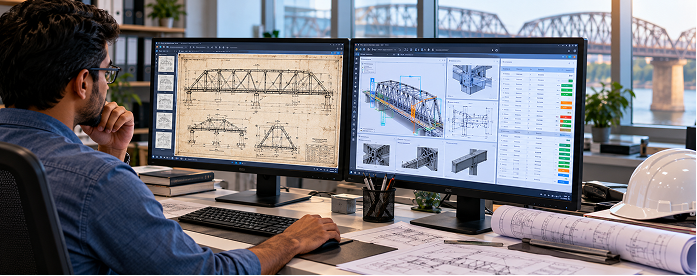
  • Visual Drawing Processing: Each sheet is processed as a visual engineering drawing, enabling extraction from scanned, hand-drawn and CAD-based plan sets without relying on existing PDF text layers.
  • Intelligent Page Triage: Relevant general-plan sheets are identified before detailed extraction, reducing unnecessary processing across large plan sets and focusing extraction on pages containing required structural information.
  • Structured Extraction with Confidence Scoring: Key attributes such as construction date, span lengths, skew, deck width, girder section and bent count are mapped into a predefined schema. Confidence is assessed independently for each field, allowing uncertain values to be flagged without affecting clearly readable data.
  • Source Traceability and Schema Validation: Every extracted value is linked to its source PDF and page number for quick verification. The system also distinguishes between unreadable and non-applicable fields, recording N/A where an attribute does not apply rather than generating an unsupported value.
  • Human Review and Continuous Improvement: Uncertain or partially legible fields are routed for human validation instead of being guessed. Verified corrections can feed into subsequent processing batches, helping improve extraction while keeping engineering review focused on the fields that require attention.

Outcome

The proof of concept demonstrated a practical approach to converting complex, century-spanning bridge plan sets into structured engineering records while keeping uncertainty visible at the field level. Instead of requiring engineers to manually review every page and every field, the workflow focuses their attention on information that genuinely needs verification. 

With intelligent page triage, visual extraction, field-level confidence and source-page traceability working together, the resulting records clearly flag fields requiring verification and allow engineers to focus review where it matters. This creates a more reliable, auditable and practical data set for downstream engineering workflows while reducing the risk of confident but unsupported values entering the record.