Linked Document Generation and Consistency Checks for PPAP Submissions

Linked Document Generation and Consistency Checks for PPAP Submissions

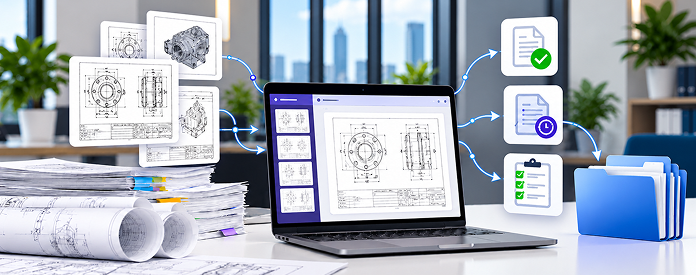
Automated PPAP management links ballooned drawing data with quality documents, validates characteristic details across the submission package, and tracks revision changes. Targeted consistency checks help teams identify mismatches, manage pending approvals, and maintain traceable documentation before PSW sign-off.

The Challenge

An automotive components supplier needed to manage PPAP submissions that can contain up to 18 interdependent quality documents, including design records, engineering changes, DFMEA, PFMEA, process flow, control plan, dimensional results, test records and the Part Submission Warrant. Preparing these records manually across spreadsheets and Word templates made it difficult to maintain a consistent characteristic definition throughout the package.

Changes introduced during drawing revisions could remain isolated to individual documents. A renumbered characteristic, tightened tolerance or newly identified special characteristic might not be reflected in the PFMEA, control plan or dimensional results. These cross-document inconsistencies created a significant submission risk. Customer rejections at PPAP are more often caused by inconsistency between documents than by problems with the parts themselves, and each rejection resets the approval cycle.

Solution

  • Drawing-Based Source of Truth: The ballooned drawing serves as the starting point for characteristic management. Balloon numbers, features, nominal values, tolerances and special-characteristic classifications are captured into a structured characteristic list, reducing repeated manual transcription across downstream records.
  • Linked Document Generation: The characteristic list drives the preparation of connected PPAP elements such as the process flow, PFMEA, control plan, dimensional results template and PSW. This establishes a common reference across documents and reduces the risk of a characteristic appearing in one record but being omitted from another.
  • Pre-Submission Consistency Checks: The workflow cross-checks characteristic numbers, tolerances, revision references, special-characteristic propagation and measurement methods across the submission package. Mismatches are identified with their corresponding document element or row, giving reviewers a specific point to investigate rather than requiring line-by-line comparison.
  • Revision-Aware Updates: When the source drawing changes, the revised characteristic information can flow through the connected documentation. The workflow also provides a record of what changed, helping engineers identify where previous values or references may require review instead of manually searching each document for outdated information.
  • Preparation, Review and Approval Workflow: PPAP elements move through defined preparation and review stages, with the submission state visible to the quality team. This provides clearer visibility into incomplete or pending items and helps identify what is preventing the package from progressing to PSW approval.

Outcome

The solution provides a structured approach to governing PPAP documentation around a common set of drawing characteristics. Rather than treating each quality record as an independent form, the workflow connects related information and makes inconsistencies visible before submission.

By combining a drawing-based source of truth, linked documentation, revision handling and targeted consistency checks, the workflow gives quality and engineering teams greater control over complex submission packages. Review effort can be directed toward actual mismatches and pending approvals, while traceable relationships between characteristics and downstream records make the package easier to validate and maintain.