
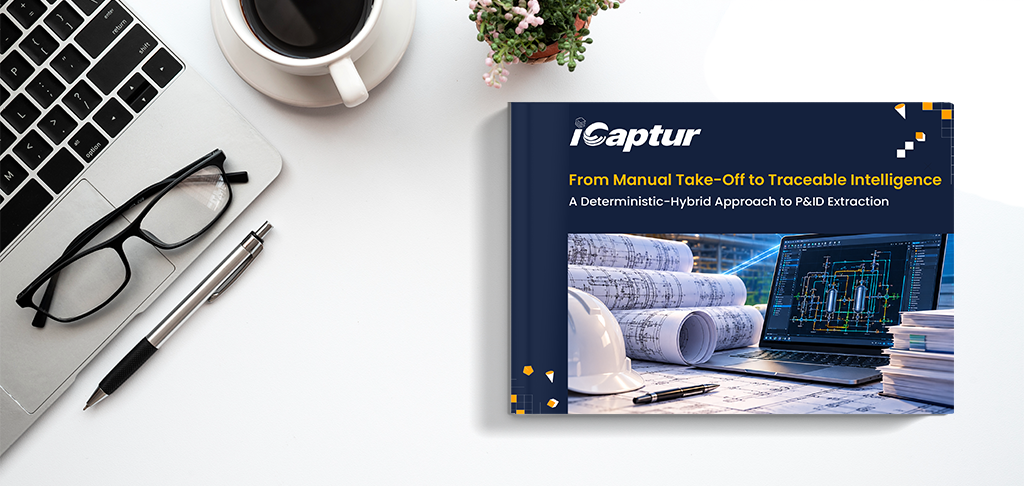
Our whitepaper, “From Manual Take-Off to Traceable Intelligence: A Deterministic-Hybrid Approach to P&ID Extraction,” examines why P&ID take-off remains one of the most manual, error-prone processes in engineering project delivery, even as drawing sets have moved from paper to native CAD and vector PDF. Digitizing the drawing never digitized the reading of it. Engineers still trace line numbers by hand and re-key quantities into a take-off, and the errors that process produces surface late, as procurement shortfalls and schedule overruns.
The real challenge isn’t another AI model that guesses at what a drawing shows. It’s resolving geometry with certainty first and applying pattern recognition only where it belongs. This whitepaper shows how a deterministic-hybrid pipeline separates what should be resolved exactly, pipeline topology, from what benefits from classification, symbol recognition, producing output an engineering team can verify rather than merely trust.
What the Whitepaper Covers:
- Why P&IDs require topology-aware extraction rather than positional OCR
- Why generic, pixel-based document AI fails on engineering drawings
- The deterministic-hybrid design philosophy: where rules govern, where ML is scoped
- The four core modules that form the extraction pipeline
- ISA-5.1 symbol classification and ASME B16.5 joint derivation
- Structured output and ERP/SAP integration architecture
- Validation results from a 120-sheet reference deployment
- Security, governance, and the bounded-scope engagement model
Download the whitepaper to understand how engineering enterprises are moving material take-off from a weeks-long manual bottleneck to a traceable, minutes-long process.