
- Solutions
-
-

CAD Solutions
Logistics Solutions
-
-
Repetitive workflows, manual data handling, and slow handoffs across teams create process bottlenecks. Teams spend time managing tasks instead of improving outcomes.
Without a real-time view of operations, it becomes difficult to track progress, identify issues early, or respond quickly. Exceptions are often discovered late, and decisions are made with incomplete information.
Business tools, data sources, and teams frequently operate in isolation. When systems cannot exchange information easily, automation becomes fragile, and insights remain difficult to act on.
As operations grow, organizations often rely on hiring more people to handle increasing workloads. When processes depend heavily on manual coordination, scaling becomes costly and difficult to sustain.
Highly skilled teams spend significant time on administrative tasks, reporting, and coordination. This limits the time available for strategic thinking, innovation, and building stronger customer relationships.

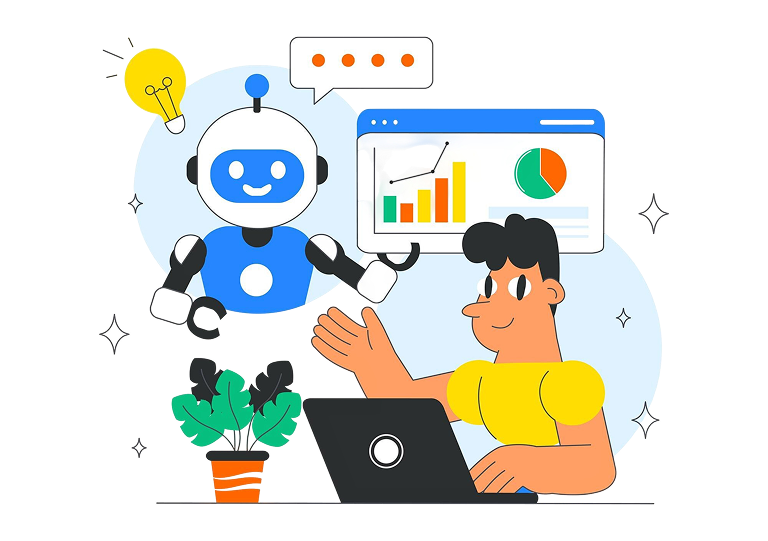
An AI agent is an autonomous software system that can understand information, make decisions, and take action to achieve a goal. Instead of waiting for step-by-step instructions, the agent evaluates situations, determines the next step, and continues working until the task is completed.
Unlike a chatbot that only responds to prompts or a script that repeats the same actions, an AI agent operates with context and intent. It can interpret inputs, choose the best action, interact with systems or tools, and move a process forward on its own.
In practical terms, an AI agent functions like a digital operator, observing what is happening, deciding what needs to be done next, and executing tasks to reach the desired outcome.
AI agents operate through a set of core components that work together to understand information, make decisions, and complete tasks. Each component plays a specific role in how the agent interprets context, plans tasks, and interacts with systems.
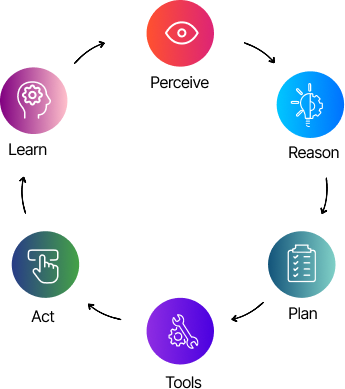
Perception is how the agent receives and interprets inputs such as user requests, documents, system events, or data streams. By analyzing these signals, the agent understands the situation and identifies the goal it needs to address.
Planning breaks a goal into smaller steps and determines the order of execution. The agent then performs actions such as calling APIs or triggering workflows.
Architecture defines how the components connect and how information flows across the agent system.
Each agent starts with the processes your teams already follow. Tasks, decisions, and system interactions are mapped so the agent understands how work moves across the organization.
Agents are configured using your data, documentation, and domain language so they interpret requests and respond in ways that match how your teams operate.
Rules and decision frameworks are defined to reflect how your teams make decisions, ensuring the agent operates within clear boundaries.
Agents maintain context during interactions while learning from past patterns, allowing them to improve performance over time.
AI agents manage workflows, coordinate systems, and make decisions that keep operations moving. This shifts automation from isolated tasks to intelligent operational support.
Agents connect tools and platforms that do not naturally communicate with each other. By interacting with APIs, databases, and applications, they move information across systems and keep workflows synchronized.
Agents take over coordination work such as tracking updates, organizing tasks, and managing routine communication. This allows teams to focus on decision-making, strategy, and problem solving.

We design and deploy specialized AI agents that automate workflows, analyze data, support decisions, and interact with systems and users across your operations.
Eliminate repetitive manual workflows by executing routine operational tasks.
Monitor data sources, analyze patterns, and surface insights that support faster decisions.
Handle customer queries, routing, and support interactions at scale.
Identify exceptions, evaluate conditions, and recommend actions to reduce operational risk.
Extract, classify, validate, and route information from contracts, invoices, reports, forms, and other documents.
Coordinate and manage multiple agents, ensuring complex workflows run from start to finish.
Retrieve and synthesize information from internal and external sources when needed.
Track systems, thresholds, and operational signals and trigger actions when conditions change.
We combine industry expertise with advanced agentic AI development to build systems that integrate seamlessly into real business operations.
We combine industry expertise with advanced agentic AI development to build systems that integrate seamlessly into real business operations.
Our team brings strong technical and domain experience, supported by technology partnerships and proven deployments.


