


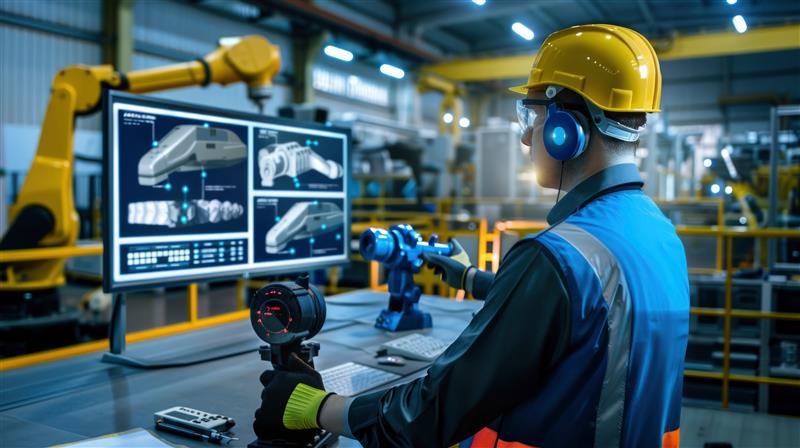
The manufacturing industry is experiencing a digital transformation driven by artificial intelligence, machine learning, and intelligent automation. As production environments become increasingly complex, manufacturers are turning to advanced software solutions to optimize operations, improve quality, and maintain competitive advantage.
Whether you’re exploring AI-powered analytics, document automation, or legacy system modernization, understanding how these technologies integrate with your existing infrastructure is essential. This comprehensive guide addresses the most common questions manufacturers ask about implementing intelligent software solutions.
AI-Powered Manufacturing Software
Which stages of my manufacturing lifecycle can I optimize using intelligent software?
Software with AI capabilities optimizes every stage of the manufacturing lifecycle. It improves design through simulation and digital twins, enhances planning with better forecasting and scheduling algorithms, and boosts production using real-time monitoring and optimization. Quality control is strengthened through automated inspection and defect prediction, while maintenance benefits from predictive analytics that prevent costly downtime. Post-production analysis supports continuous improvement through performance benchmarking and actionable insights.
What types of operational insights can I gain from advanced analytics and predictive models?
Advanced analytics and machine learning models provide visibility into demand patterns, production bottlenecks, quality deviations, equipment health, resource utilization, and potential operational risks. These insights enable proactive decision-making rather than reactive firefighting, helping manufacturers shift from corrective to preventive strategies. Predictive models can forecast equipment failures, identify quality issues before they escalate, and optimize production schedules based on real-time constraints.
Can new solutions be integrated with my existing manufacturing applications and systems?
Yes. Modern intelligent solutions integrate seamlessly with existing ERP, MES, quality management, and supply chain systems using APIs, connectors, and middleware platforms. This ensures business continuity without disrupting current operations, allowing you to enhance capabilities incrementally while preserving your technology investments.
How can I effectively use historical and legacy manufacturing data for analysis and forecasting?
Legacy data represents valuable institutional knowledge. Data extraction tools pull information from legacy files and historical repositories, then structure and clean it for analysis. Custom-built analytics systems enable trend analysis, forecasting models, and performance benchmarking, transforming dormant historical data into actionable intelligence that improves future operations.
Can these solutions be tailored to my specific plant processes and workflows?
Absolutely. Solutions are customized to reflect your unique plant layouts, standard operating procedures, data structures, and business rules. This customization ensures alignment with how your teams actually work, rather than forcing them to adapt to generic software workflows. Configuration options address industry-specific requirements, compliance needs, and operational constraints.
We have an initial idea. Can you help us move it forward?
Yes. Rapid prototyping services turn conceptual ideas into functional proof-of-concept models. This approach validates requirements early, tests workflows with actual users, identifies potential issues, and reduces implementation risk before full-scale development begins. Iterative development cycles ensure solutions evolve based on real feedback from your production environment.
Intelligent Document Processing
Which manufacturing documents can I automate for data extraction and processing?
Intelligent Document Processing (IDP) can automate data extraction from engineering drawings, blueprints, CAD files, technical specifications, inspection reports, bills of materials, quality certificates, invoices, purchase orders, and other structured or semi-structured manufacturing documents. Computer vision and natural language processing technologies extract critical information from tables, forms, and technical diagrams with high accuracy.
How can document automation support procurement, production, and quality operations end to end?
Document automation eliminates manual data entry bottlenecks, accelerates approval workflows, improves data accuracy across systems, and ensures timely information flow from procurement through production planning to quality checks and regulatory reporting. Automated extraction and validation reduce processing time from hours to minutes, enabling faster response to production requirements and supplier communications.
Can document-driven workflows connect directly with my ERP, MES, and quality systems?
Yes. Document-driven workflows integrate directly with ERP platforms, MES software, and quality management systems, enabling seamless data transfer and eliminating manual handoffs between systems. APIs and integration middleware ensure extracted data flows automatically to downstream applications, maintaining data consistency and traceability throughout your digital ecosystem.
How can I bring older documents, scanned files, and PDFs into a unified workflow?
Legacy documents, scanned files, and PDFs are digitized using optical character recognition (OCR) and intelligent classification algorithms. Content is automatically structured and normalized, allowing older documents to be processed alongside newer digital-native files within a single unified workflow. This creates a complete document repository spanning your organization’s entire operational history.
How can poor-quality scans, handwritten inputs, and inconsistent formats be handled accurately?
Advanced extraction techniques powered by computer vision and deep learning handle skewed scans, faded text, handwriting variations, and inconsistent document layouts. Confidence scoring mechanisms flag uncertain extractions for human review, while validation workflows ensure accuracy is maintained even with challenging source materials. Machine learning models continuously improve as they process more documents.
How long is extracted document data stored, and can retention rules be controlled?
Uploaded documents and extracted data are retained for only 24 hours, after which they are automatically deleted. This short retention period reduces long-term data exposure and strengthens privacy protections. Organizations can configure retention policies based on their specific compliance requirements and data governance frameworks.
How is sensitive data protected while meeting global compliance requirements?
The platform complies with GDPR, CCPA, HIPAA, and ISO/IEC 27001 standards through encrypted storage, role-based access controls, continuous security monitoring, and privacy-first workflow design. Data protection extends to third-party integrations with ERP platforms, ensuring sensitive manufacturing data remains secure throughout its lifecycle, even when shared across enterprise systems.
Legacy System Modernization
I already have a software system in place with no intelligent capabilities. Can it be upgraded?
Yes. Existing software can be enhanced by adding AI and machine learning capabilities through modular upgrades, API integrations, and intelligent data layers—without replacing the entire system or disrupting current operations. This evolutionary approach preserves your technology investments while introducing advanced capabilities incrementally.
How do I modernize old enterprise systems without disrupting day-to-day manufacturing operations?
Modernization follows an incremental approach, allowing critical legacy systems to continue running while newer components are introduced, tested, and stabilized in parallel. Phased rollouts, pilot programs, and parallel operation periods ensure production continuity while technical teams validate new functionality and train users progressively.
How can I ensure modernization improves performance and scalability instead of creating new bottlenecks?
Systems are redesigned to eliminate architectural constraints, optimize data flows, implement efficient algorithms, and leverage cloud-native scalability. Performance improvements are measured through KPIs and benchmarking, ensuring modernization delivers tangible benefits as operations grow. Load testing and capacity planning prevent new bottlenecks from emerging.
What risks should I plan for during data migration and system integration?
Common risks include data inconsistencies, system downtime, integration failures, and user adoption challenges. These risks are assessed early through comprehensive discovery and mitigated through careful planning, phased migration strategies, data validation protocols, parallel testing runs, and rollback procedures. Contingency plans address potential issues before they impact production.
What happens if modernization introduces security or compliance gaps?
Solutions comply with GDPR, CCPA, HIPAA, and ISO/IEC standards from design through implementation. Encrypted storage, strict access controls, continuous security monitoring, and privacy-first workflows maintain compliance throughout modernization. Security assessments and penetration testing identify vulnerabilities before systems go live.
How do I maintain business continuity and minimize downtime during modernization?
Modernization is executed in controlled phases with parallel environments, blue-green deployment strategies, and minimal maintenance windows. Critical operations continue uninterrupted while systems are gradually upgraded and validated. Rollback capabilities ensure rapid recovery if issues arise, protecting production schedules and customer commitments.
How do I ensure new systems support future needs like analytics, automation, and cloud integration?
Solutions are built using modular, cloud-ready architectures with microservices, containerization, and API-first design principles. This foundation supports advanced analytics platforms, robotic process automation, IoT integration, and seamless connectivity with emerging technologies. Future-proofing ensures your technology infrastructure evolves with industry innovation.
How can a modernization initiative deliver measurable business ROI?
ROI comes from reduced IT maintenance costs, improved operational efficiency, faster decision-making through real-time data access, enhanced customer responsiveness, and scalable systems that support growth without proportional cost increases. Tangible metrics include reduced downtime, lower error rates, faster cycle times, and improved resource utilization aligned with long-term strategic objectives.
How do you standardize and reuse data stored in outdated or siloed formats?
Platforms like iCaptur handle diverse legacy formats by extracting, structuring, and normalizing data into standardized schemas. This enables consistent reuse across modern applications, business intelligence tools, analytics platforms, and forecasting workflows—transforming isolated data silos into integrated information assets.
Machine Learning Implementation
What outcomes can I expect from advanced analytics and machine learning in my operations?
You gain deeper operational visibility through real-time dashboards, pattern recognition in production and quality data, improved decision-making supported by predictive insights, and refined KPIs that guide strategic improvements. Machine learning identifies subtle correlations humans might miss, enabling optimization opportunities across maintenance scheduling, quality control, inventory management, and production planning.
How can we improve visual inspections and make better use of drawings and images across operations?
Computer vision and convolutional neural networks analyze images, detect objects and anomalies, classify defects, extract data from technical drawings and diagrams, and automate visual quality inspection. These capabilities improve consistency, reduce inspection time, and capture defect patterns that inform root cause analysis and continuous improvement initiatives.
How do you handle text-heavy and unstructured data from reports, manuals, and communications?
Natural language processing (NLP) and large language models process text from reports, technical manuals, work instructions, and communications by extracting key information, detecting entities, identifying structured data within unstructured content, and converting documents into searchable, analyzable formats. This reduces manual information retrieval effort and surfaces insights hidden in textual data.
How can generative models help with content and knowledge work in manufacturing teams?
Generative AI can produce, summarize, and refine technical documentation, standard operating procedures, training materials, and maintenance manuals. These models support automation-ready content generation tailored to your specific terminology, processes, and quality standards—accelerating knowledge capture and standardization across facilities.
Can you tailor machine learning models to my manufacturing data and use cases?
Yes. Custom model development and fine-tuning ensure solutions are trained on your specific data, delivering context-aware results aligned with your workflows, terminology, and business objectives. Transfer learning and domain adaptation techniques apply proven AI architectures to your unique manufacturing environment.
How do we ensure these systems remain accurate and relevant as our operations and data change over time?
Continuous learning pipelines and model monitoring enable systems to adapt as new data arrives and operational conditions evolve. Models can be retrained incrementally, maintaining relevance and improving performance without complete rebuilds. Drift detection alerts signal when model accuracy degrades, triggering retraining workflows automatically.
Can your AI solutions integrate with my existing systems and tech stack?
Yes. AI capabilities integrate with cloud platforms (AWS, Azure, Google Cloud), on-premises infrastructure, ERP systems, document management systems, and databases through standard APIs, message queues, and data pipelines. This avoids disruptive rewrites while extending existing technology investments with intelligent capabilities.
How is my data handled securely and in compliance with regulations?
Data is managed through secure cloud architectures, encrypted communication channels, role-based access control, and adherence to HIPAA, GDPR, SOC 2, ISO 27701, and ISO 27001 standards. Data governance frameworks keep information protected at every stage—from collection through processing, storage, and deletion.
What benefits can my business expect from custom-developed ML models?
Custom models deliver more accurate predictions for your specific processes, personalized solutions addressing unique challenges, high reliability in routine automated tasks, better strategic decisions from data insights, stronger security through controlled deployment, operational cost efficiency, and competitive differentiation through proprietary AI capabilities.
Adoption, Security, and Support
Are there real use cases showing how automated extraction from engineering drawings improves manufacturing workflows?
Yes. Detailed whitepapers and customer case studies demonstrate measurable improvements in accuracy, reductions in manual data entry effort, and acceleration of downstream manufacturing workflows—from BOM creation to production planning. These resources are available in the whitepapers and customer stories sections, showcasing ROI across various manufacturing verticals.
How are engineering drawings and extracted data processed and stored securely to meet enterprise and regulatory standards?
Technical drawings and extracted data are processed in secure cloud environments with encrypted storage, network isolation, controlled access based on roles and responsibilities, and continuous monitoring for security events. Compliance with enterprise security policies and regulatory requirements like ISO standards is maintained throughout the data lifecycle.
Is there a way to try the extraction capabilities using my own documents before adopting at scale?
Yes. Our experience platform allows you to upload and test your own engineering drawings, specifications, and documents directly to evaluate extraction accuracy, workflow performance, and business value in real-time. You can explore the capabilities hands-on with your actual files before committing to enterprise-wide adoption and scaling.
How can teams request support or additional extraction capabilities for specific drawing formats or requirements?
Technical support teams are available through dedicated channels to discuss custom requirements, troubleshoot issues, and explore enhancements for specific drawing formats, CAD standards, or industry-specific notation systems. Custom extraction models can be developed for specialized document types.
What policies govern how long uploaded technical files and extracted results are retained?
Uploaded files and extracted data follow a 24-hour retention policy and are automatically deleted afterward to minimize long-term data exposure. This short retention window strengthens data privacy while allowing sufficient time for validation and integration workflows. Extended retention requires explicit configuration based on compliance requirements.
How is compliance with data protection standards ensured?
Compliance is maintained through adherence to global data protection regulations (GDPR, CCPA), strict internal controls, regular security audits, penetration testing, employee training, secure development practices, and privacy-by-design principles across all processing stages. Third-party security assessments validate compliance posture regularly.
Ready to Transform Your Manufacturing Operations?
Intelligent software solutions are no longer optional for manufacturers competing in today’s fast-paced market. Whether you’re looking to extract value from legacy systems, automate document-intensive processes, or deploy machine learning for predictive insights, the right technology partner can accelerate your digital transformation journey.
Start with a pilot project, evaluate results against your KPIs, and scale what works. The future of manufacturing is intelligent, connected, and data-driven—and it’s available today.
Contact us to discuss how AI-powered solutions can address your specific manufacturing challenges and drive measurable business outcomes.