


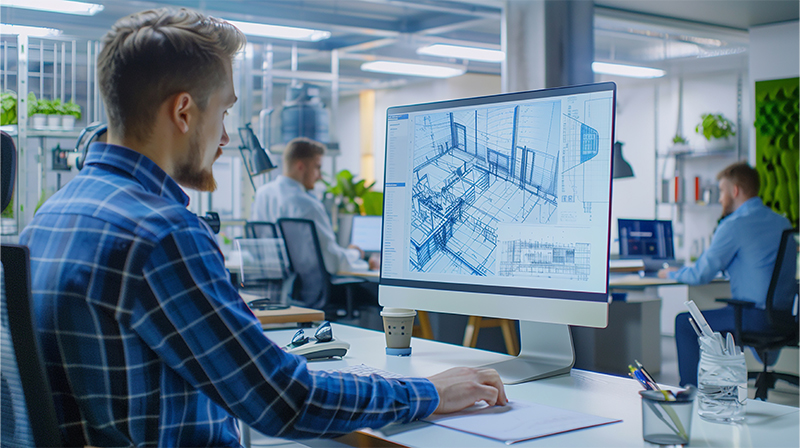
The architecture and engineering (A&E) sector is undergoing a digital shift fueled by artificial intelligence, machine learning, and intelligent automation. As project complexity grows and client expectations rise, firms are turning to advanced software solutions to enhance design accuracy, streamline documentation, and improve project delivery.
Whether you’re exploring AI-aided design analysis, automated drawing processing, or legacy system upgrades, understanding how these tools integrate into your existing workflows is critical. This guide answers the most common questions A&E firms ask about adopting intelligent software.
Project Lifecycle Optimization & Integration with AI Systems
Which stages of my project lifecycle can I optimize using intelligent software?
AI optimizes the entire A&E lifecycle—enhancing conceptual design through generative simulations, improving planning with automated compliance and BIM coordination, streamlining documentation via drawing validation, supporting construction monitoring, and enabling post-project performance analysis for continuous improvement.
Can new solutions be integrated with my existing design and project management systems?
Yes. Modern intelligent solutions integrate seamlessly with existing CAD/BIM platforms, project management software, ERP, and document management systems using APIs, connectors, and middleware. This ensures continuity without disrupting ongoing projects, allowing you to enhance capabilities incrementally while preserving current software investments.
Can these solutions be tailored to my specific firm workflows and project types?
Absolutely. Solutions are customized to align with your firm’s project stages, design standards, delivery methods, and quality procedures. Configuration addresses discipline-specific requirements (civil, structural, MEP), regulatory compliance, and client-specific deliverables, ensuring the software supports how your teams work.
We have a concept in its early stages. What's the process to prototype and validate it?
Yes. Rapid prototyping services transform conceptual ideas into functional proofs-of-concept. This approach validates requirements early, tests workflows with actual users, identifies potential issues, and reduces implementation risk before full-scale development. Iterative cycles ensure solutions evolve based on feedback from your project environment.
Can your AI solutions integrate with my existing design and business systems?
Yes. AI capabilities integrate with cloud platforms (AWS, Azure, Google Cloud), on-premises servers, BIM/CAD tools, document management systems, and business software via APIs, message queues, and data pipelines. This extends current technology investments without disruptive overhauls.
How do you handle text-heavy and unstructured data from reports, specs, and correspondence?
Natural language processing (NLP) and large language models process text from specifications, meeting notes, RFIs, and manuals by extracting key clauses, identifying obligations, detecting entities, and converting documents into searchable, analyzable formats. This reduces manual retrieval time and uncovers insights buried in text.
Data, Analytics, and Machine Learning Models
What kinds of operational insights can advanced analytics and predictive modeling deliver?
Advanced analytics and machine learning models provide visibility into project risks, resource allocation, design performance, schedule adherence, cost overruns, and client change patterns. These insights support proactive decision-making, helping firms shift from reactive issue management to predictive project control. Models can forecast delays, identify design clashes early, and optimize team workloads based on real-time data.
What outcomes can I expect from advanced analytics and machine learning in my projects?
You gain deeper project insight through real-time dashboards, pattern detection in design and construction data, improved forecasting of schedules and costs, and data-driven decision support. Machine learning uncovers subtle correlations like design choices impacting buildability, enabling optimization across planning, detailing, and delivery.
How can generative models help with content and knowledge work in A&E teams?
Generative AI can produce, summarize, and tailor project narratives, specification sections, proposal drafts, and training content. Models support automation-ready documentation aligned with your firm’s style, terminology, and quality standards—accelerating knowledge sharing and standardization.
Can you tailor machine learning models to my firm’s data and project types?
Yes. Custom model development and fine-tuning ensure solutions are trained on your project data, delivering context-aware results aligned with your workflows, design standards, and business goals. Transfer learning adapts proven AI architectures to your specific A&E domain.
How do we ensure these systems remain accurate and relevant as our projects and data evolve?
Continuous learning pipelines and model monitoring allow systems to adapt as new project data arrives. Models can be retrained incrementally, maintaining relevance without full rebuilds. Drift detection alerts trigger retraining when accuracy declines, keeping performance aligned with changing conditions.
What benefits can my firm expect from custom-developed ML models?
Custom models deliver more accurate predictions for your project types, personalized solutions for firm-specific challenges, reliable automation of routine tasks, better strategic decisions from data insights, enhanced security through controlled deployment, operational efficiencies, and competitive differentiation via proprietary AI tools.
How can we improve drawing reviews and make better use of images and models across projects?
Computer vision and convolutional neural networks analyze drawings, detect clashes, validate compliance, extract data from technical images, and automate quality checks. These capabilities improve review consistency, reduce oversight time, and identify recurring design issues for continuous improvement.
Intelligent Document Processing & Drawing Automation
Which A&E documents can I automate for data extraction and processing?
With Intelligent Document Processing (IDP), you can automate data extraction from architectural drawings, engineering schematics, BIM models, site surveys, specification sheets, compliance certificates, invoices, purchase orders, contracts, and submittal logs. Computer vision and NLP extract critical information from drawings, schedules, and forms with high accuracy.
How does document automation streamline workflows across the entire project lifecycle, from design to construction?
Document automation eliminates manual drawing reviews, accelerates approval workflows, improves data consistency across platforms, and ensures timely information flow from design through tendering to construction administration. Automated extraction and validation reduce processing time from hours to minutes, enabling faster responses to RFIs and change orders.
Can document-driven workflows connect directly with my BIM, CAD, and project management systems?
Yes. Document-driven workflows integrate directly with BIM platforms (Revit, ArchiCAD), CAD software, and project management tools, enabling seamless data transfer and eliminating manual handoffs. APIs ensure extracted data flows automatically to downstream applications, maintaining consistency and traceability across your digital project environment.
What is the process for integrating legacy drawings, scanned plans, and PDFs into a modern, unified digital workflow?
Legacy drawings, scanned plans, and PDFs are digitized using OCR and intelligent classification. Content is automatically structured and normalized, allowing historical documents to be processed alongside current digital files in a single workflow. This creates a complete project archive spanning your firm’s entire history.
How can systems accurately process low-quality scans, handwritten annotations, and non-standard drawing formats?
Advanced extraction techniques powered by computer vision and deep learning handle faded prints, skewed scans, handwritten notes, and non-standard layouts. Confidence scoring flags uncertain extractions for human review, while validation workflows ensure accuracy. Machine learning models improve continuously as they process more drawings.
How can AI help identify compliance issues and code violations in engineering drawings?
AI validation engines automatically check drawings against building codes (IBC, IRC), accessibility standards (ADA), fire safety codes (NFPA), MEP codes, and client specifications—flagging missing elements, safety violations, and non-compliant dimensions.
Can validation workflows be customized for different project types or client requirements?
Yes. Validation rules can be customized for residential vs. commercial projects, new construction vs. renovations, specific client standards, and regional code variations.
Can AI help accelerate cost estimation and bidding processes?
Yes. Automated BOM extraction links to pricing databases, generating preliminary estimates in minutes. This accelerates bid preparation, enables scenario analysis, and improves accuracy.
Can cost estimation integrate with supplier pricing databases and historical project data?
Yes. AI connects BOMs to supplier catalogs, internal pricing databases, historical cost data, and market indices for real-time validation and benchmarking.
How does AI ensure consistency across multidisciplinary drawings from architectural, structural, and MEP teams?
Cross-disciplinary validation detects clashes between layouts and structural elements, identifies MEP conflicts, verifies dimensional consistency, and flags discrepancies before construction.
Legacy System Modernization & Data Reuse
I already have design or management software with no intelligent capabilities. Can it be upgraded?
Yes. Existing systems can be enhanced by adding AI and machine learning modules via APIs, plugins, or intelligent data layers—without full replacement or operational disruption. This evolutionary approach preserves your technology investment while introducing advanced features incrementally.
How do I modernize old systems without disrupting ongoing projects?
Modernization follows an incremental, phased approach. Legacy systems continue running while new components are introduced and tested in parallel. Pilot projects, staged rollouts, and parallel operation periods ensure project continuity while teams validate new functionality and adapt gradually.
How can I ensure modernization improves performance and scalability instead of creating new bottlenecks?
Systems are redesigned to eliminate legacy constraints, optimize data flow, implement efficient algorithms, and leverage cloud scalability. Performance gains are measured via KPIs and benchmarks, ensuring modernization supports larger projects and more complex designs without new bottlenecks.
What risks should I plan for during data migration and system integration
Risks include data and format inconsistencies, integration failures, and user resistance. These are mitigated through thorough discovery, phased migration, data validation protocols, parallel testing, and rollback plans. Contingency strategies address potential issues before they impact live projects.
How are potential security or compliance risks addressed during modernization?
Solutions comply with GDPR, CCPA, ISO/IEC, and industry regulations from design onward. Encrypted storage, strict access controls, continuous security monitoring, and privacy-aware workflows maintain compliance. Security assessments and penetration testing identify vulnerabilities before go-live.
How can organizations ensure continuity of operations and reduced downtime while systems are being modernized?
Modernization uses phased deployments, blue-green strategies, and minimal maintenance windows. Critical project work continues uninterrupted while systems are upgraded gradually. Rollback capabilities ensure quick recovery if issues arise, protecting project timelines.
How do I ensure new systems support future needs like generative design, IoT, and cloud collaboration?
Solutions are built on modular, cloud-ready architectures with microservices, containerization, and API-first design. This foundation supports emerging tools like generative AI, IoT sensor integration, and real-time cloud collaboration, future-proofing your technology stack.
How can a modernization program generate measurable business ROI?
ROI comes from reduced IT overhead, faster project delivery, improved design accuracy, enhanced client satisfaction, and scalable systems that support growth without linear cost increases. Measurable outcomes include fewer design errors, reduced rework, faster drawing production, and better resource utilization.
How can data locked in legacy or siloed formats be standardized and reused effectively?
Platforms like iCaptur extract, structure, and normalize data from legacy formats into standardized schemas. This enables consistent reuse across modern BIM tools, analytics dashboards, and reporting systems—turning isolated project archives into integrated knowledge bases.
How can I effectively use historical and legacy project data for analysis and forecasting?
Legacy drawings, past project reports, and historical specifications contain valuable institutional knowledge. Data extraction tools pull information from legacy files and repositories, then structure and clean it for analysis. Custom analytics enable trend spotting, risk forecasting, and benchmarking, turning archived project data into actionable intelligence for future work.
Security, Compliance, and Data Governance
How long is extracted document data stored, and what is your data retention rule?
Uploaded drawings and extracted data are retained for only 24 hours by default, after which they are automatically deleted. This short retention reduces long-term data exposure. Firms can configure retention policies based on project requirements, compliance needs, or data governance frameworks.
How is sensitive project data protected while meeting global compliance requirements?
Sensitive project data is protected through encryption, secure cloud storage, role-based access controls, continuous monitoring, and compliance with global standards such as GDPR, ISO 27001, and industry security regulations.
How is my project data handled securely and in compliance with regulations?
Data is managed through secure cloud architectures, encrypted channels, role-based access, and adherence to GDPR, ISO 27001, SOC 2, and industry-specific standards. Governance frameworks protect information from collection through processing, storage, and deletion.
How are drawings and extracted data processed and stored securely to meet enterprise and regulatory standards?
Technical drawings and extracted data are processed in secure cloud environments with encrypted storage, network monitoring. Compliance with enterprise policies and standards like ISO is maintained throughout the data lifecycle.
What policies govern how long uploaded drawings and extracted results are retained?
Uploaded files and extracted data follow a 24-hour default retention policy, after which they are automatically deleted to minimize data exposure. Extended retention can be configured based on project, legal, or compliance needs.
How is compliance with data protection standards ensured?
Compliance is maintained through adherence to global regulations (GDPR, CCPA), strict internal controls, regular security audits, penetration testing, staff training, secure development practices, and privacy-by-design across all processing stages. Third-party assessments validate compliance posture regularly.
Adoption, Testing and Support
Are there real use cases showing how automated extraction from drawings improves A&E workflows?
Yes. Detailed whitepapers and customer case studies demonstrate measurable gains in drawing processing accuracy, reductions in manual review time, and acceleration of downstream workflows—from specification writing to bid preparation. These resources showcase ROI across various A&E disciplines.
Is there a way to try the extraction capabilities using my own drawings before adopting at scale?
Yes. Our experience platform allows you to upload and test your own engineering drawings, specifications, and documents directly to evaluate extraction accuracy, workflow performance, and business value in real-time. You can explore the capabilities hands-on with your actual files before committing to enterprise-wide adoption and scaling
How can teams request support or additional capabilities for specific drawing formats or standards?
Technical support teams are available via dedicated channels to discuss custom requirements, troubleshoot issues, and develop enhancements for specific CAD formats, layer standards, or regional notation systems. Custom extraction models can be built for specialized document types.
Ready to Transform Your A&E Practice?
Intelligent software solutions are essential for architecture and engineering firms aiming to deliver higher-quality projects faster and within budget. Whether you’re looking to unlock value from legacy drawings, automate document-heavy processes, or deploy AI for predictive insights, the right technology partner can accelerate your digital evolution.
Start with a pilot project, measure results against your KPIs, and scale what works. The future of A&E is intelligent, integrated, and data-informed—and it’s available now.
Contact us to discuss how AI-powered solutions can address your firm’s specific challenges and deliver measurable project and business outcomes.