



Introduction
Operational workflows have quietly outgrown the tools designed to manage them.
What once lived within a single department now stretches across ERP, CRM, and procurement platforms, fueled by continuous data streams and cross-functional coordination. While this digital expansion has increased capability, it has also introduced a new layer of friction: unprecedented complexity.
Workflows are no longer linear; they branch, loop, and stall across fragmented tools and document repositories. This shift leaves teams trapped in a cycle of manual coordination, suffering from delayed decision-making and limited visibility into live operations. When your architecture demands more cognitive bandwidth for “chasing exceptions” than for strategy, you’ve hit the ceiling of traditional automation.
This blog explores why rigid, task-based tools struggle in these dynamic environments and how Agentic AI introduces a goal-driven, adaptive approach to bridge the gap in modern operational management.
The Growing Complexity of Operational Workflows
The modern operational environment is anything but simple. Today’s enterprise runs on a “permanent complexity” model, where workflows are no longer contained within neat silos. Instead, they are defined by a high-velocity exchange between multiple interconnected platforms—from ERPs and CRMs to internal data lakes.
This environment is shaped by four defining characteristics:
- Platform Fragmentation: Data scattered across systems that rarely speak the same language.
- Data Velocity: Unending streams of transactional and operational signals.
- Document Density: Heavy reliance on unstructured data like contracts and invoices.
- Cross-Functional Coordination: Processes requiring synchronized input across disparate teams.
Because these processes rarely follow a straight line—often bouncing between a vendor portal, an approval queue, and a finance dashboard—visibility gaps are inevitable. The result isn’t just a minor delay; it’s operational friction. When teams spend their day context-switching and chasing exceptions, the business suffers from increased error rates, compliance exposure, and a total lack of real-time insight into ongoing execution.
Why Rule-Based Automation Cannot Solve a Dynamic Problem
Traditional automation—RPA bots, scripted workflows, and trigger-based integrations—was engineered for predictability. The formula is simple: define the rule, map the path, and execute at scale. For high-volume, low-variance tasks, this model is highly effective. However, the architecture hits a ceiling the moment reality deviates from the script.
Rule-based systems are inherently brittle because they rely on:
- Rigid Logic Gates: They execute perfectly until a scenario arises that the designer didn’t anticipate.
- Structured Input Dependence: A script cannot interpret an invoice formatted differently or handle data it wasn’t programmed to recognize.
- System Silos: Traditional tools operate within a single system at a time; they lack the “cross-platform vision” to perceive broader operational context.
In a modern environment, this creates a manual intervention trap. When workflows involve shifting conditions or unstructured documents, rule-based tools don’t manage complexity—they simply fail silently or escalate to a human. Because these tools cannot plan or adapt, they leave your teams to bridge the gaps, resulting in the very friction they were designed to eliminate.
What Agentic AI Changes
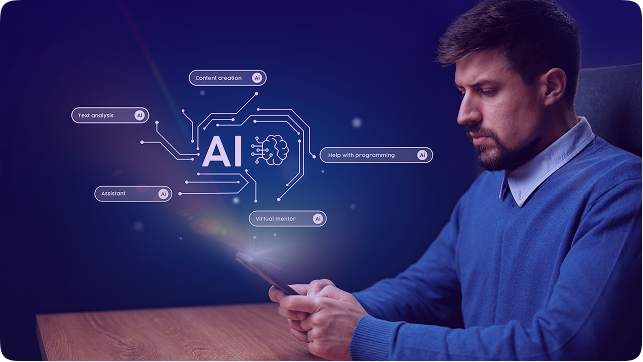
Agentic AI represents a fundamental architectural shift: moving from instruction-driven scripts to goal-driven operations. While traditional automation follows a rigid command, an AI agent interprets context, evaluates the current state of a workflow, and determines the necessary actions to reach a defined outcome—all without waiting for step-by-step direction.
This shift allows automation to move beyond isolated tasks toward managing broader, end-to-end operational processes. The core distinction lies in how these systems process work:
- Scripts: Follow predefined, linear commands.
- Chatbots: Respond to specific user prompts.
- AI Agents: Interpret context, plan sequences, and work autonomously toward objectives.
How AI Agents Operate in Workflows
This is not an incremental improvement on existing automation. It is a different operational model. Agents bring four capabilities that traditional tools categorically lack:
- Perception — Agents interpret diverse inputs: user requests, document contents, system alerts, API signals, and live data streams simultaneously.
- Planning — They decompose a high-level objective into executable tasks, sequencing them logically based on dependencies and available resources.
- Execution — Agents act directly within enterprise tools, triggering workflows, updating records, sending communications, and routing approvals across systems.
- Memory — They retain context across interactions, meaning a workflow doesn’t reset every time new information enters the process.
The practical implication is clear: agents operate across your entire enterprise architecture, not within a single application silo.
The Strategic ROI of Agent-Based Operations
Organizations deploying agentic AI at the operational level are reporting outcomes that static automation simply cannot replicate. The value concentrates in five areas:
- Autonomy at scale — Agents manage multi-step workflows end-to-end, eliminating the human coordination layer that slows every handoff.
- Proactive responsiveness — Rather than waiting for a trigger, agents continuously monitor systems and respond to emerging conditions before they escalate into disruptions.
- Parallel execution — Multiple agent-driven workflows run simultaneously without resource contention, a level of scalability that linear scripts and human teams cannot match.
- Cross-system interoperability — Agents bridge data silos, pulling context from disparate platforms to make decisions that reflect the full operational picture.
- Reduced cognitive load — Your teams stop managing process logistics and start managing outcomes. That shift has measurable impact on both productivity and talent retention.
Operational efficiency gains are only half the story. The other half is risk mitigation. Organizations running high-transaction, multi-system environments carry significant exposure every time a manual handoff introduces an error, a delay, or a missed exception. Agentic AI removes that exposure systematically, not by adding oversight, but by removing the conditions that create risk in the first place.
The compounding effect is measurable. Teams recover hours previously lost to coordination. Decision cycles shrink. And the operational capacity your business already has gets used more intelligently, without adding headcount.

Beyond General Workflows: Departmental Applications
While agentic AI enhances overall operations, its real impact is often seen in specialized, high-stakes functions.
Sales & Revenue Operations: Closing the Speed-to-Lead Gap
The Operation: Lead qualification and personalized outreach across high-volume prospect pipelines.
The Agent’s Role: Agents autonomously research prospects, analyze intent signals from CRM data, and craft hyper-personalized messaging, without human input at each stage. No bandwidth ceiling. No missed follow-up. No prospect falling through the cracks because your SDR team’s calendar was full.
Why It Matters: Every hour a high-intent prospect waits is an hour your competitor is using. The speed-to-lead gap is a silent revenue leak that scales with your pipeline volume. Agentic AI eliminates it entirely, ensuring no high-value opportunity is lost to human bandwidth limits, regardless of time zone, team size, or campaign volume.
HR & Talent Acquisition: Eliminating the Administrative Drop-Off
The Operation: End-to-end candidate lifecycle management, from screening to onboarding.
The Agent’s Role: Agents coordinate complex interview loops across time zones, handle candidate FAQs 24/7, and trigger onboarding workflows the moment a contract is signed, all without recruiter intervention. Your hiring team stays focused on evaluation and relationship-building, not scheduling logistics.
Why It Matters: Top candidates don’t wait five business days for scheduling confirmations. They accept the offer that moves fastest. Reduced time-to-hire and
lower drop-off rates translate directly into a stronger talent pipeline, lower cost-per-hire, and a candidate experience that reflects well on your employer brand before day one.
Supply Chain & Logistics: From Reactive Firefighting to Proactive Control
The Operation: Real-time freight tracking and exception management across global supply chains.
The Agent’s Role: When a delay is detected, the agent doesn’t send an alert and wait. It calculates downstream inventory impact, identifies the most cost-effective alternative route or carrier, and prepares a re-routing proposal for the logistics manager to approve, all before the disruption reaches your warehouse floor. Your team makes the call. The agent does the groundwork.
Why It Matters: The shift from reactive to proactive isn’t semantic. It means fewer stockouts, lower expedite costs, and reduced deadhead miles — measurable margin recovery at operational scale. Exception management stops being a crisis and starts being a controlled process.
Finance & Procurement: 100% Audit Coverage Without 100% Headcount
The Operation: Three-way matching and continuous fraud detection across procurement workflows.
The Agent’s Role: Agents compare invoices, purchase orders, and receiving reports continuously and at full volume. When a discrepancy surfaces, the agent contacts the vendor directly to request a correction and logs the complete resolution trail for compliance documentation — no human queue, no delay, no dropped threads.
Why It Matters: Manual spot-checks leave overpayments and fraud vectors silently undetected across high-transaction environments. Full audit coverage, zero leakage, without scaling your finance headcount or slowing down your procurement cycle. Every transaction accounted for. Every audit trail intact.

Types of AI Agents and Their Purpose
The Agent Ecosystem: Specialized Roles, Coordinated Outcomes
Mature agentic deployments don’t rely on a single general-purpose agent. They operate as coordinated systems, purpose-built agent types working in concert to manage complexity that no single tool, team, or workflow could handle alone.
Here is the breakdown:
- Workflow Agents act as the operational orchestrators: routing tasks, triggering downstream actions, and ensuring multi-step processes advance without manual intervention. They are the connective tissue between every system in your enterprise stack.
- Document Processing Agents handle the unstructured data challenge that breaks every rule-based automation tool — extracting, classifying, and structuring information from contracts, invoices, reports, and forms for immediate use in downstream workflows. No more manual data entry. No more processing backlogs.
- Monitoring Agents maintain continuous visibility across systems and data streams, identifying anomalies, threshold breaches, or emerging exceptions before they require escalation. They don’t wait for problems to surface. They find them first.
- Decision Support Agents synthesize data from multiple sources to surface actionable recommendations, giving your leadership teams the analytical depth they need without the research overhead. Faster insights. Sharper decisions.
- Research and Knowledge Agents connect your teams to institutional knowledge, pulling relevant precedents, documentation, and data from internal repositories to accelerate problem-solving at every level. The right information reaches the right person at the right moment.
Individually, each agent type closes a specific operational gap. Deployed together, they form an operational intelligence layer that sits across your entire enterprise stack — one your organization currently doesn’t have and increasingly cannot afford to operate without.
The Organizations That Move Now Will Define the New Operational Standard
Automation has followed a clear evolutionary arc. Task automation gave way to workflow automation. Workflow automation is now giving way to agent-driven operations. Each transition has raised the performance floor and widened the gap between organizations that moved early and those that waited.
The reality is, traditional automation was never designed for the operational complexity your teams are navigating today. Agentic AI brings what rule-based tools fundamentally cannot: adaptability, context awareness, and goal-driven execution across systems, documents, and teams.
The enterprises building this infrastructure now are not running pilots. They are building operational moats.
Your workflows are already complex. Your teams are already stretched. The question is no longer whether to automate, but how intelligently that automation is designed, and which bottlenecks you eliminate first.
Ready to find out where agent-based systems will have the highest impact on your operations? Let’s map it together — schedule a consultation with our team today.
Conclusion
OCR invoice processing is now a core capability for finance teams seeking to move beyond manual, error-prone workflows. By automating data extraction, validation, and system integration, OCR brings speed, accuracy, and consistency to the entire invoice lifecycle. It reduces bottlenecks, improves visibility, and supports smarter financial decisions without increasing workload. As businesses scale and operations become more complex, OCR provides the reliability and flexibility needed to keep finance functions efficient, compliant, and future-ready.
Enhancing your workflow through
AI integration is key to future success.
processes and improve efficiency!


I design and refine AI solutions that make workflows smarter and turn data into actionable insights. With expertise in OCR, deep learning, and computer vision, I focus on translating complex concepts into reliable, scalable systems that solve real-world problems and create measurable value.